
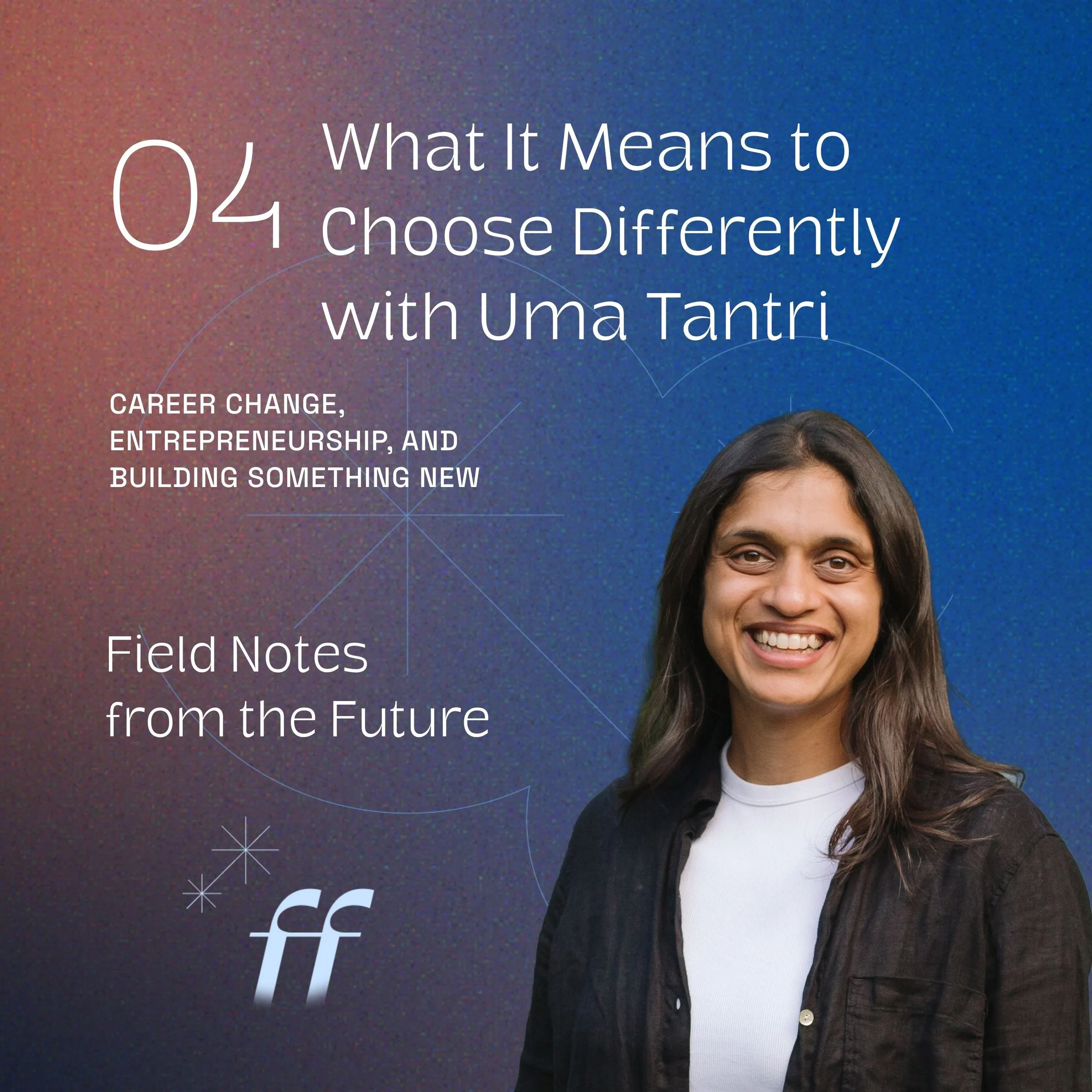
What happens when the life that looks right on paper no longer feels aligned?
Uma Tantri spent years trying to marry the need for financial stability with a career in management consulting and consumer goods, work she describes as never quite letting her be at peace. Motherhood changed the calculus. When she couldn't find her daughter a snack that wasn't loaded with hidden sugars, she started making her own. That kitchen problem became Meena's Planet.
In this conversation, Uma and Shannon talk about the tension between stability and meaning, what it actually took to give herself permission to leave a traditional path, and why choosing differently isn't one bold decision but a series of smaller ones, made again and again.
This is a conversation about the personal evolution required to build something new when the old path no longer fits.
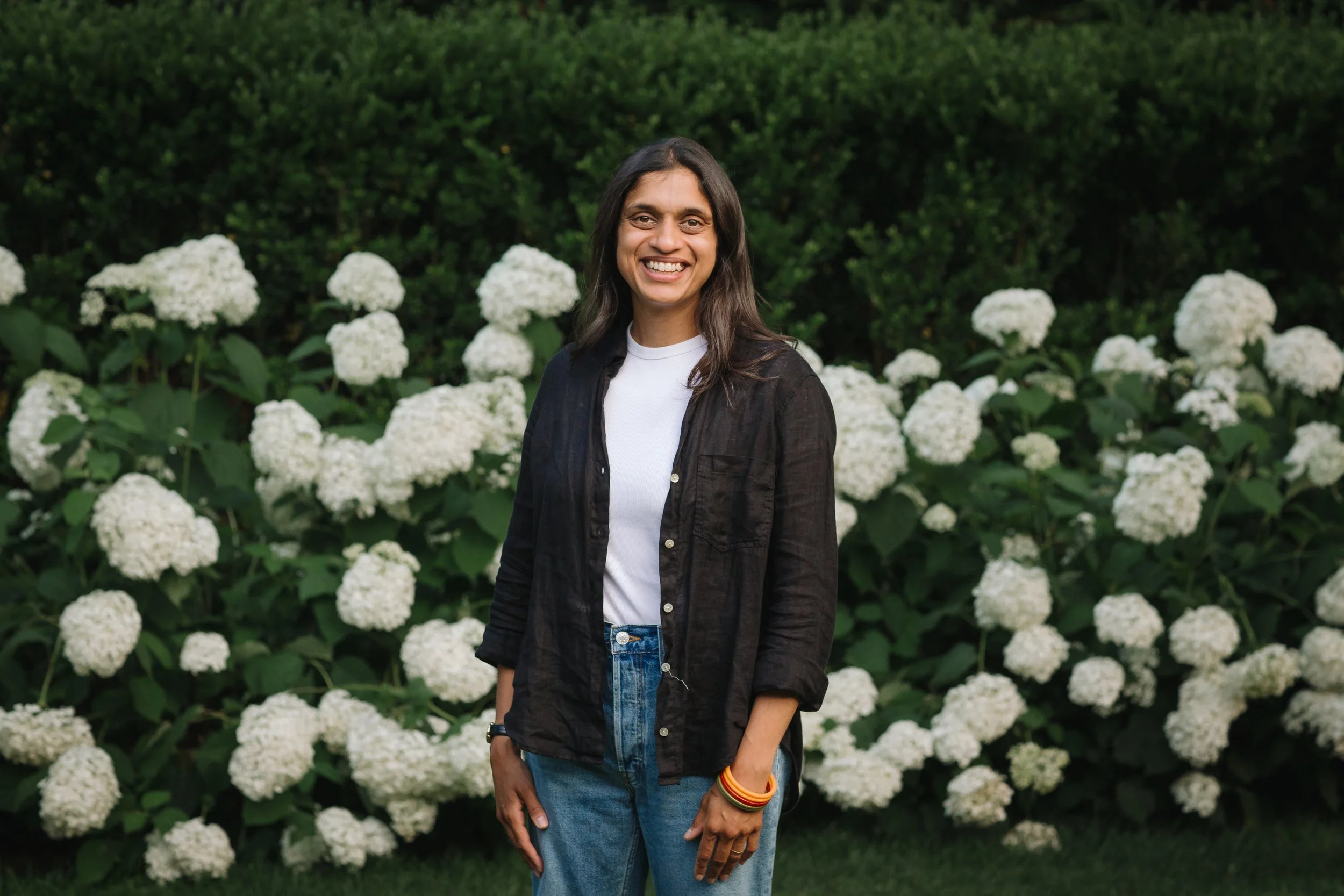
Uma Tantri
Founder, Meena's Planet
Uma Tantri is a founder, mother, and former CPG and consulting professional. In 2025, she launched Meena's Planet, a regenerative snack company focused on creating healthier food systems for children and the planet.
The company's debut product, Sheepies, is a regenerative organic alternative to goldfish crackers, developed after Uma couldn't find a snack for her daughter Meena that was free of hidden sugars and high-sodium ingredients.
She holds a B.A. from Middlebury College and an M.B.A. from UC Berkeley Haas, and lives in Brooklyn with her family.
What we explore in this conversation
- ✦ Motherhood as the catalyst that turned an abstract food systems problem into something personal and urgent
- ✦ From a gap on the snack aisle shelf to Sheepies: the origin of Meena's Planet
- ✦ A college research project on industrial agriculture that turned a love of food into a systems concern
- ✦ The long tension between financial stability and personal alignment, from hospitality to business school to big CPG
- ✦ Choosing full time founder life over oscillating between corporate stability and entrepreneurship
- ✦ What manufacturing minimums and retail slotting fees reveal about who gets to build a healthier food system
- ✦ Redefining leadership as a solo founder: holding empathy and excellence as the same standard, not a trade-off
The tension is going to bed at night and wondering: can I really wake up tomorrow morning and do this again?
— Uma Tantri, Episode 04
Once I became a mom, I realized my energy is not that expendable.
— Uma Tantri, Episode 04
This does not feel like a solo pursuit.
— Uma Tantri, Episode 04
From this episode
- Meena's Planet Website coming soon
- Aurora Collective auroracollective.partners ↗
Credits
Graphic Design: Maggie Famiglietti
Video & Audio Production and Editing: Raul Zahir De Leon, Weald Studio
A Conversation with Uma Tantri
This transcript has been lightly edited for clarity and readability while preserving the spirit and substance of the conversation.
Shannon
The food system shapes what we eat, how we live, and what we pass on to the next generation. Uma Tantri knew this long before she felt it personally. Motherhood has a way of making the abstract urgent, and that led her to step away from a traditional career in consulting and consumer goods to start Meena's Planet. What followed wasn't a single bold decision, but a series of shifts toward something more honest, more values aligned, and more attuned to what she knows her family, and our food system, actually need. This is a conversation about what it takes to choose differently, even when you're right in the middle of it.
Shannon
Welcome to Field Notes from the Future. I'm so happy to have you here with us, and we're going to jump right in.
Uma
Thanks, Shannon. It's always great to spend some time with you.
Shannon
It's so great. I feel like we could talk to each other forever about so many things. Today we're just going to talk about your story. For listeners who may not know you, who are meeting you for the first time, how do you introduce yourself and the work you're doing in the world right now?
Uma
Most days I introduce myself as a mom, but I'm also a sister, a daughter, a friend, and more recently a founder, an identity I'm still trying to get comfortable with. It doesn't really roll off the tongue. In 2025, I started working on a project to launch Meena's Planet, a regenerative organic kid snack company. We make wholesome snacks to keep our kids thriving and our planet thriving and safe for generations to come.
Shannon
I know we're going to hear so much more about that. Where did it start?
Uma
It actually started from a concept for a nonprofit that I believe I'll still start one day, a regenerative organic CPG company that operates in a completely different way: one that returns profits to growers to support their transition to regenerative organic practices, and offers a direct sales path. The idea was for it to be a nonprofit, so we could rebuild some trust in our food system.
Uma
To back up, my daughter Meena was born in 2022. I had gestational diabetes when I was pregnant with her, and the doctors said that she and I will always be at higher risk of developing type 2 diabetes in our lifetime. Since she was born, and especially once she started solids around five or six months and moved off formula and breast milk, she needed to start meeting this insatiable snacking appetite. Once she graduated from the baby and toddler aisle, there was this huge cliff in nutritional value in the cookie, cracker, and snack aisle, as I like to call it.
It was fine until preschool, because until then I controlled everything she ate. We'd pack what was in the fridge, and it was all quite healthy, whole foods, fresh. Then at school there were lots of other snacks and treats coming in, often loaded with sugar, and we couldn't let her eat those every day. I went to a natural grocer and could not find a snack that was fun for her and wasn't filled with hidden sugars and high sodium ingredients we don't stock in our pantry.
Uma
They're a wholesome, regenerative organic alternative to goldfish crackers. I started with goldfish because that was the thing Meena and I would fight about at every birthday party. I started making them, and her friends started eating them too, kids who ate all the other snacks out there in the cookie and cracker aisle. Then their parents started asking me for them. That's when my husband and I looked at each other and said, we actually have a way to build a financially sustainable, regenerative organic kid snack company, and we don't need the nonprofit anymore. That's how it started. We're about sixty bench tests later now, with a locked formula we're heading into R&D with.
Shannon
I love how this story reflects the values you have around what you care about and what you're up to in the world. I also know this isn't what you've always done. When you look back across your career and your life, what moments or experiences feel most formative in shaping and getting you to this point, launching a regenerative organic product?
Uma
I have to thank my therapist for this one, because she's encouraged me to give credit to the decisions I've made along the way. I used to be really self-conscious about my professional background, because it's varied, and I made choices that didn't make sense to my family or my employer at the time. But it all served a purpose: pursuing what mattered most to me in the moment. When I was in college, there's a lot of pressure on kids to do well in school and get into a good college, which sets you up for a stable career. I did all of that without questioning it much. Then in college, someone asked me what I liked to do, and I couldn't answer the question. I didn't know.
So I spent the next year watching where my interests would naturally go, and I kept coming back to food. I studied abroad in Madrid and designed an independent study around the local markets there. And in my senior year, I did my research on industrial agriculture in the United States and realized how significant its negative externalities are on the environment, on public health, on local economies. About 30 percent of greenhouse gas emissions come from our food system. One in five children in the U.S. is now obese, and about 12 percent of adults have diabetes. We support this system with roughly $14 billion a year in agricultural subsidies, and the most subsidized crop is corn, most of which goes to ethanol or corn syrup rather than food we actually need. I got obsessed with sustainable food systems after that.
Uma
When I graduated, I went into hospitality, even though everyone around me was doing consulting and banking interviews, because I knew deep down I wanted to work in food. I was far from the impact I wanted to have, but I learned how to run a small business, which is a skill that serves me today: you face problems, you learn about them, and you solve them. You don't need a degree for that.
Shannon
When did you start to feel the tension between what looked like the stable path and what actually felt meaningful and sustainable to you? How do you characterize that tension?
Uma
I was proud of the work I did in hospitality and I had a lot of fun and learned a lot, but I couldn't support a family on it. I realized I was far removed from the sustainable food systems work that got me into food in the first place. So I went to business school, which felt like a pragmatic way to approach the tension. I applied to the Haas School of Business at UC Berkeley because I wanted to go to Haas specifically. It's rooted in social entrepreneurship, and there was a professor dedicated to food and sustainable food systems there. I thought, now I can work in CPG, marry the desire for stability with working in an area I care about, since big CPG controls our supply chain.
There was a stop in management consulting along the way to gain more skills, and eventually I led strategy and insights for a big CPG beverage company, still an agricultural product at its core. But I still couldn't sleep at night. In absolute terms, the paycheck was enough to support a family, that's not what I mean, but it wasn't enough to let me be at peace inside.
Uma
So I started a granola business in 2020. I convinced my employer to let me work reduced hours while I launched Uma's Granola, watching it grow alongside my corporate job. Then I got pregnant, and my health started to suffer, and the tension was now manifesting physically, not just as sleeplessness. I felt more fulfilled launching something I cared about, since I'm very entrepreneurial, but then the realities of needing stability took over again. I keep oscillating between the two. Now I'm pregnant again, and this time we've made the decision that if I'm going to be successful with Meena's Planet, I have to be full time on it. I can't do a corporate job at the same time.
Shannon
It sounds like that's what made it personal and urgent, aligning your values with the work you wanted to do and the life you wanted to live. There's something here about what we know about high-achieving, purpose-oriented women: at some point, in absolute terms, the paycheck doesn't balance the equation against the cost to your values, and it sounds like the cost to how you were living and what you had to compromise and adapt.
Uma
Completely. I saw it among my peers too, other women, especially when the work I was doing in a lot of those corporate settings, I didn't even know if it would be used. I'd present a deck, the analysis I'd done, whether I'd spent a week or six months on it with a whole organization, and they might or might not act on it.
Uma
Yes, that comes with financial stress right now, and I recognize the privilege in being able to do this, because financially we're in a position where I can step away from the corporate job to launch this. I get to go to my daughter's classroom for a volunteer reading or a craft, or go to doctor's appointments without being completely stressed, knowing that when I do work, I'm only doing the highest priority item, and it will actually be used, because I'm not going to waste my own time.
Shannon
Building Meena's Planet has clearly brought its own pressure and responsibility. How does this season feel different from the stress you experienced in more traditional corporate roles?
Uma
It's a quieter stress. It's low level, it keeps me up at night. Startup ups and downs, as a friend who's helping me launch calls it, and the downs can feel really down, especially when it's, well, if I can't overcome that obstacle, we can't launch. That keeps me up at night, because to do this we've made a financial decision for our family. That means we can't save for Meena's future, her college or our retirement, because I'm foregoing income. In corporate, what kept me up at night was that I couldn't breathe, the stress of meeting deadlines or not being able to give my team the empathy and kindness I believe should be in the workplace. It was exhausting, physically and mentally, and that creates health problems, and there's no time or space to recover from them. It's a vicious cycle that's a lot louder and more externally visible. Right now the stress is quiet, it's personal, it's in our household. But I'm so grateful to have people, especially my partner Charlie, to say, this is going to change Meena's future, and it's going to keep her safe when we're not around. So we have to invest our time and resources in it.
Uma
I love working with people and teams. So many people have touched Meena's Planet and the brand, and I actually struggle to say "I" when discussing it, even though I am technically a solo founder. I've learned that I need to be amongst community at all times, and I've developed a rich community of friends, family, and professional colleagues. I've realized I need to build that bigger, faster than I thought I wanted to, because I crave being around people, and it's genuinely good for my mental health versus working from home by myself.
Shannon
What are you learning about the food system itself?
Uma
I could have started with a different product. I have other products I'd love to launch after Sheepies, which I'm working to launch this year. In trying to commercialize Sheepies, I'm realizing why we don't have more regenerative organic options on the shelf. To make this style of cracker, you need a production line, a tunnel oven that can produce thousands of pounds at a time. Most manufacturers quote minimums of a hundred thousand, five hundred thousand, even a million pounds, which is a lot of money in tolling for a startup to pay. Some would do smaller runs, but only if you used their grains and oils, and they weren't interested in organic, which is a moot point if the ingredients aren't organic to begin with. That's part of why the only brands in this category tend to be existing big brands, or ones with a massive platform elsewhere to leverage.
There's also the scale of slotting fees brands pay just to get on shelf at major retailers, which the brand pays directly, and if there's a discount being offered, the brand is usually providing that too. That keeps small brands trying to bring a different quality of product to market from being able to participate.
Shannon
You're talking about two different systems there: production and sourcing, and then retail.
Uma
That's a great point, and sourcing is actually the part that gives me the most hope. There are so many growers right now getting regenerative organic certified through the Regenerative Organic Alliance, the most stringent standard out there, and more who'd like to be. If I can figure out the manufacturing and retail pieces, I think it's lights out, in a good way. Retailers are craving regenerative organic certified products to meet their own ESG and sourcing goals, so we don't even need the average consumer to know what the certification means yet. I'd be remiss not to say I'm only able to do this because companies like Patagonia Provisions, Lundberg Family Farms, and Dr. Bronner's have been paving this path for decades, and generously so. Patagonia Provisions in particular has been so generous with their time and insight, through a network of women and women-identifying founders who resource each other. That generosity is a gift, and I want to pay it forward, because I think that's how we build a more just food system.
Shannon
How do you think about your leadership right now?
Uma
Honestly, my first reaction is, it's just me, how am I a leader? But as I've been quietly building Meena's Planet with a team of amazing consultants around food safety, graphic design, and copy, I keep coming back to the aspects of leadership I hope to bring to a team: leading with empathy and kindness and thoughtfulness, equally with excellence. Those are often seen as trade-offs. I don't think they have to be. I hold myself to incredibly high standards, which is why I can't always sleep, and I've learned there's a lot that's out of my control and uncertain. Building the internal resilience to stay empathetic and thoughtful and kind, and excellent, when things are uncertain, that's the hard part, including being kind to myself.
Uma
The dean of Haas at the time, Rich Lyons, told us in orientation that at business school you go from the mindset of "they do that" to "I do that." I'm realizing this year that I'm actively in that shift. It's full of uncertainty, which is why I keep post-its on my wall and surround myself with people who remind me: you are doing it. I never thought I'd talk about this before we launched, but more companies need to exist that believe in exchange, not extraction, that believe you can be empathetic and excellent at the same time, so parents can make it to their kid's school parade at 11:30 and not be stressed about it. That's the leader I want to work for, and the leader I'm trying to be, even in this very messy middle.
Shannon
When you imagine Meena growing up having witnessed how you designed your life and work, what do you hope she understands about success and what's worth protecting?
Uma
I hope she learns, much earlier than I figured it out, that her mental health and physical health are the most important things in her life, and that protecting them like treasures matters most. I hope she sees this dream become a true reality, at the scale I believe it can be, and that it was only possible because of an incredible community of people. I'm a solo founder on paper, but this doesn't feel like a solo pursuit.
Uma
I'd be remiss not to emphasize the role my husband Charlie plays, picking me up off the kitchen floor when I feel like I can't overcome a challenge, and my friends from Middlebury and from Haas, many of whom are parents too, who've propelled this idea forward through countless conversations, whether about the business or just as friends over dinner. That's what gives me the energy and longevity to keep going, even though this is taking longer than I'd ideally like. I hope she sees that there are a lot of important people in her parents' lives who made this possible.
Shannon
Thanks for listening to Field Notes from the Future. This podcast is one expression of Aurora Collective, a platform where women leaders are helping coalitions and changemakers turn complexity into clarity and vision into action. If today's conversation sparked something for you, share this episode, subscribe, and keep imagining with us. You're not alone in this work, and the future is already on its way.