
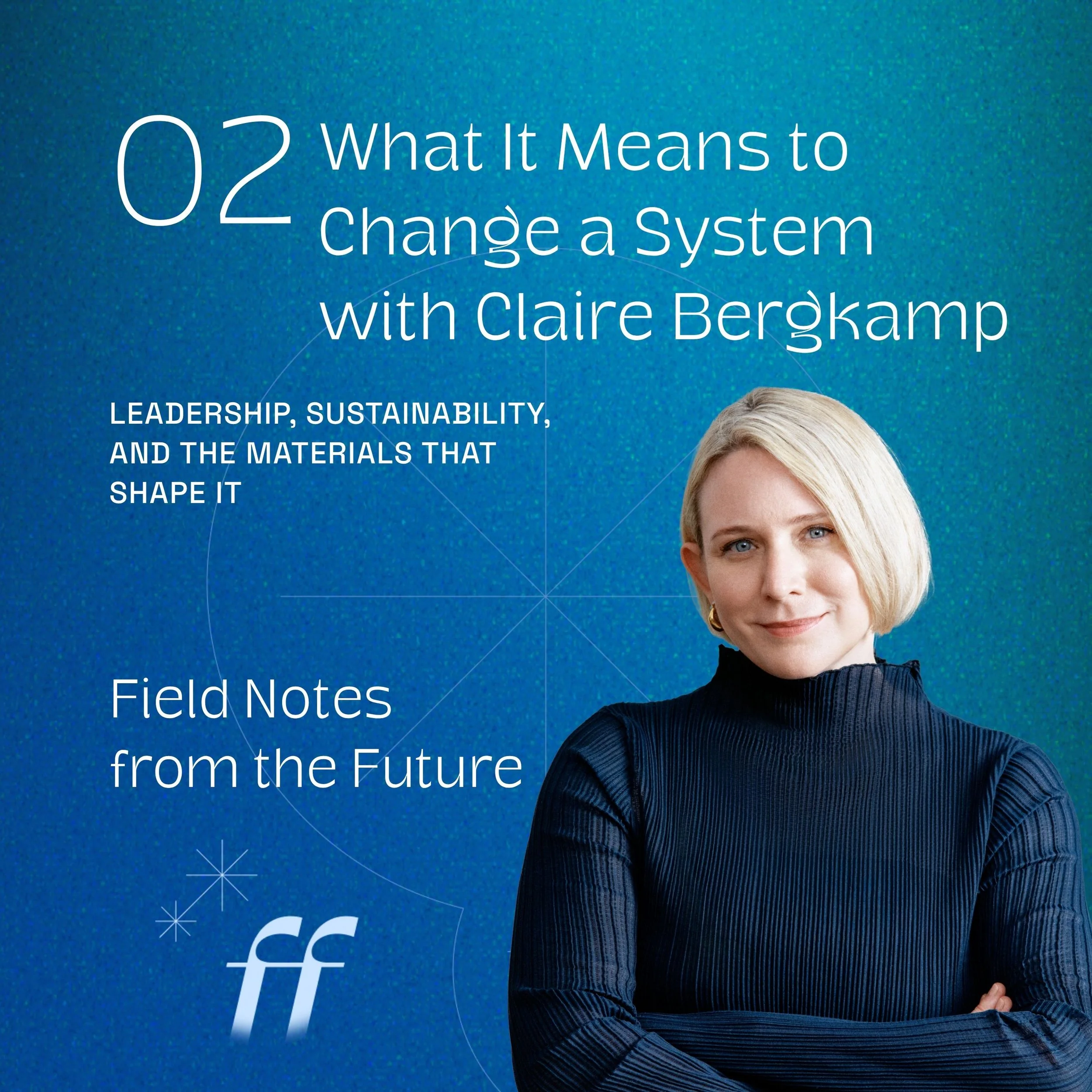
How does personal evolution shape the way we work inside complex systems?
Claire Bergkamp shares how her leadership has evolved alongside a deeper understanding of what's needed to address climate and sustainability at scale. Her work now focuses on materials as a critical lever for change: shifting the foundation of the fashion industry itself.
This is a conversation about leadership, decision-making, and what it takes to change systems from within, by aligning our work with what the future demands.
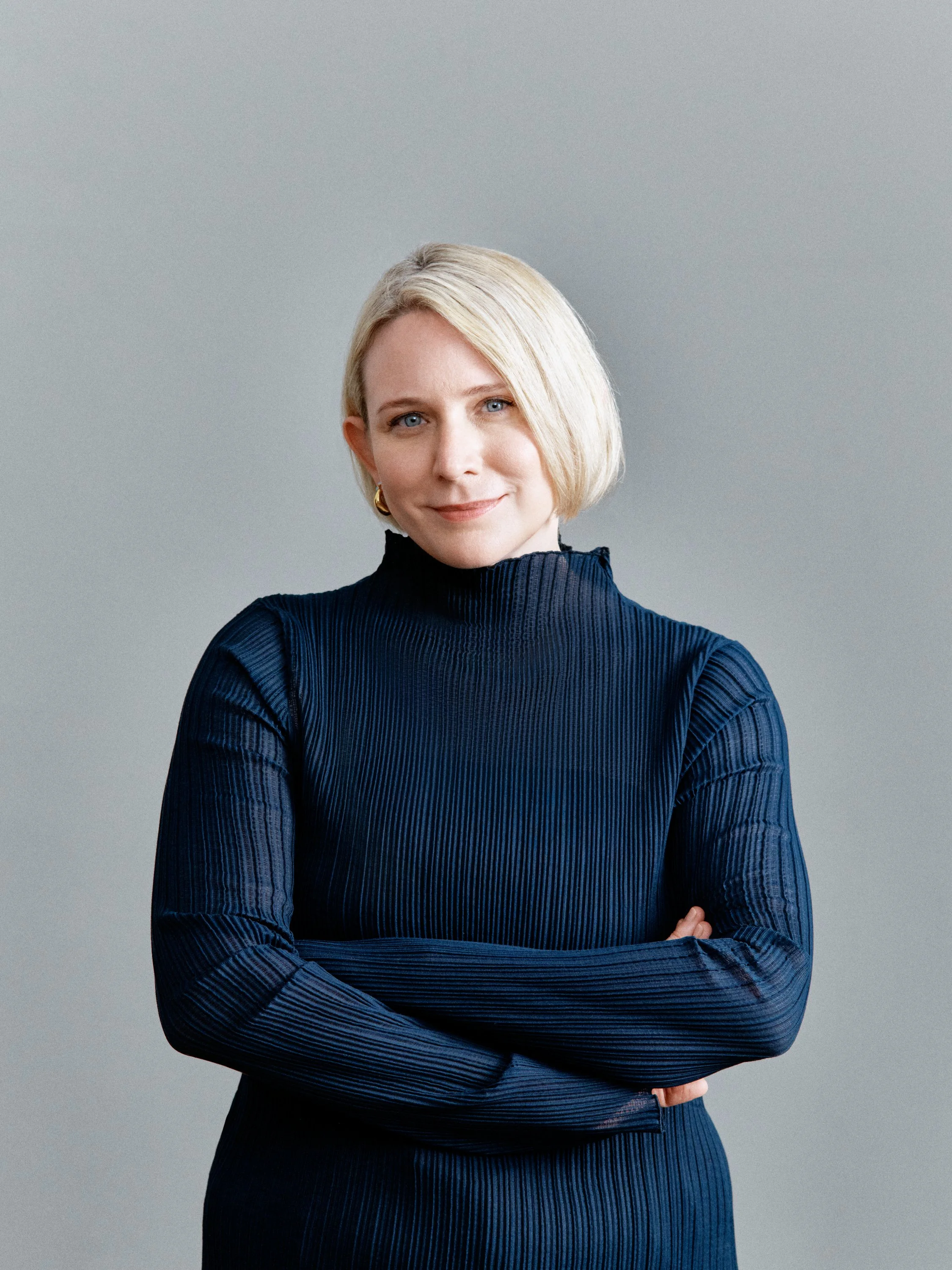
Claire Bergkamp
CEO, Textile Exchange
Claire Bergkamp is the CEO of Textile Exchange and a global leader in sustainability strategy within the fashion industry. She previously served as Sustainability and Innovation Director at Stella McCartney and has played a key role in industry-wide climate initiatives, including the UN Fashion Industry Charter for Climate Action.
What we explore in this conversation
- ✦ Why "raw materials" is the more precise term for the beginning of the fashion supply chain, and why that beginning is where the leverage is
- ✦ From costume design to raw materials: a career built by following internal fulfillment over external validation
- ✦ What growing up around ranching, farming, and conservation in Montana taught her about working with nature, not against it
- ✦ The real difference between leading inside a brand and leading a nonprofit built on influence rather than authority
- ✦ Systems change is just people making decisions: what it actually takes to shift practices on the ground
- ✦ The frustration and hope inside farming communities being asked to do more without always being paid for it
- ✦ Choosing purpose over perception when deciding what comes next
It's not feeling afraid to change. Change can be exciting.
— Claire Bergkamp, Episode 02
How I can add value and do something that's not about me, that's how I've found happiness in work.
— Claire Bergkamp, Episode 02
The system is just someone in a factory making a decision. It's somebody else in a mill making a decision.
— Claire Bergkamp, Episode 02
From this episode
Credits
Graphic Design: Maggie Famiglietti
Video & Audio Production and Editing: Raul Zahir De Leon, Weald Studio
A Conversation with Claire Bergkamp
This transcript has been lightly edited for clarity and readability while preserving the spirit and substance of the conversation.
Shannon
Most sustainability conversations start at the end: what we buy, what we wear, what we throw away. Claire Bergkamp starts at the beginning. As CEO of Textile Exchange, she works at the level of raw materials, the cotton, wool, and synthetics that shape what fashion does to farmers, communities, and our planet. But underneath the work is a through line, a deep, abiding connection to nature, and this has guided every step of her career. This is a conversation about leading from your values and what becomes possible when you do.
Shannon
Claire, thanks so much for being here, for joining us. It's so wonderful to have you. I'm going to start by asking you how you introduce yourself. How do you talk about the work you do in the world and who you are?
Claire
Thank you for having me. Always great to get to talk to you. So how I introduce myself, well, it depends who I'm talking to, but in this context, it's that I run a nonprofit in the sustainability space, climate and nature space, trying to help the fashion industry do less harm by focusing at the beginning of the system on how materials are produced, and helping companies make better decisions around the materials they use, and supporting the community that actually makes those materials to adopt climate and nature-friendly practices.
Shannon
You've said before that this is always hard to describe.
Claire
Yes, because there's an assumption that people know the materials that go into their clothing, which is a big assumption, since it's not something everyone thinks about. I used to try to describe what I did by talking about raw materials, but came to learn a lot of people don't know what that means. So just "materials" is what I talk about now. Sometimes I talk about the standards work we do, that if you're purchasing something and you see a recycled certification or an organic certification or a responsible wool certification, that's our work too. We create the standards that connect the farm or the processing facility all the way to the finished product and the label.
Shannon
This has not always been your career. I'd love to hear about your path, from costume design to corporate sustainability to now leading a global nonprofit, and what some of the early signals were.
Claire
I've had, like many folks, a kind of winding career trajectory. I grew up in Montana and originally thought I wanted to be a fashion designer, but I realized I was more interested in the character side of design and got interested in costume design. I did my undergraduate degree in costume design at Emerson College in Boston, and when I finished I moved to LA and worked in the film industry for almost four years. I got into a film union quickly, which meant I got real access to big projects, TV sets and films, working as a costumer, purchasing, on shows like Heroes and Glee.
I could see, at a pretty young age, that where I was going wasn't where I wanted to get. The dream of costume design was about the psychology of clothing, the research side. The reality was a lot of quick turnaround purchasing. I got very interested in sustainability during that time too, because I was so in the belly of the beast from a consumerism point of view. Growing up in Montana, I grew up with a real sense of the environment, a lot of conservationists in my community. I started asking, how is this stuff made? I think for a lot of young people, the entry point into sustainability in fashion is waste, and that was mine too: how are we treating this so disposably?
Claire
Around 2010, there wasn't a ton in the US connecting sustainability and fashion, so I found a program in London tied to the Centre for Sustainable Fashion, led by Dilys Williams. I did a business-focused program there, fashion entrepreneurship, but did all my research through the Centre, connecting the business side of the industry to the sustainability case. It was a reset, a very different turn at twenty-five.
Shannon
It sounds like you moved from external validation, being good at something, to internal fulfillment, being aligned with something you cared about.
Claire
Yes, and that was the difference. Design never got me that excitement, even though it used parts of my brain I liked using, the problem-solving parts. This work does too, but it's the right fit in a way design wasn't. There was an identity alignment that was a lot cleaner. I'd built a very clear identity for myself at a young age around being a designer, and that's a strange thing to let go of. But when you find the identity that actually fits, there's so much relief in that. It let me redirect ambition toward impact, and maybe a little less toward prestige.
Shannon
What other moments made it clear something needed to change?
Claire
After my master's, I moved into corporate sustainability in the luxury fashion industry for almost a decade. That was amazing for a long time, joining a brand at the moment the luxury industry was embracing sustainability for the first time. I got the kind of deep, on-the-ground education of how the world works in manufacturing, from the farm through every step, cleaning, processing, spinning, dyeing, weaving, sewing, and how differently that looks in China versus India, Hungary versus Italy.
What I learned in that work was that the part that excited me most was raw materials, the beginning of the supply chain, which ties back to how I grew up. In many parts of the manufacturing system there are opportunities to do less bad. But in raw materials, in agriculture, there's an opportunity to do good, to have nature-positive practices. That's what I couldn't get enough of.
Shannon
What was it like making the shift from corporate to nonprofit?
Claire
Wonderful and challenging. There's so much clarity in a corporate structure that doesn't exist in a nonprofit. In a fashion brand, everyone is aligned in service of the product, the collections, the deadlines. It's black and white by comparison. A nonprofit, especially in a space this multifaceted, has no single goal. We have a 45 percent emission reduction goal for the industry by 2030, but that's a long-term goal we don't directly control. We're there to influence. The boundaries, the plans, you have to create them from scratch, in real time, as the science and the politics evolve.
I also stepped into a co-leading position when I joined, as part of an active succession plan with LaRhea Pepper, one of the co-founders and at the time CEO. We co-led for a couple of years. There was real benefit early on, I was learning a lot from someone who'd been doing it for twenty years, but at a certain point, having two people in charge stopped being as additive, especially for the team, in an organization where clarity was so critical. We evolved out of that over time.
Shannon
You've said that systems are just people making decisions. What are you noticing about that from where you sit now?
Claire
When you're at a brand, you're the one holding the purchasing decision. If I'm asking a supplier to change their sourcing practices, someone down the chain has to decide whether they'll actually embed that, make it a long-term shift, or just do it once because I asked and never again. Understanding who you're working with, what context and constraints they're dealing with, that's everything.
Claire
One of my major shifts on the brand side was working with a pulp mill to change their wood sourcing practices for viscose production. If we'd just asked, they probably would have sold us certified pulp once. But we took the time to understand what it would mean for them to only do this, how we could rely on them as a key supplier, how we could share that commitment. That's a very different thing, and it takes getting to know the people who are actually making those decisions.
Shannon
What does it mean for you to center the people, the farmers and ranchers, and the land itself?
Claire
Honestly, it's just calm. When you're actually there, talking with producers and growers who understand their land and their context, there's this inherent clarity that comes from seeing how this can work in balance, not extraction or depletion. There's also frustration in that community, because a lot of individuals can see the opportunity and know what it will take, but it often costs more to do things in a balanced way, and that long-term cost of soil health and water cleanliness isn't embedded in how we currently calculate cost. People doing the right thing sometimes feel punished rather than rewarded for it.
With the volatility in the industry since the pandemic, brands have looked for cost-cutting measures, and that tension is real. What do we want to value? How do we reward the people making sure there's still soil in six harvests from now? I think about their frustration and their excitement both. There's real joy in reconnecting with how to do this in sync with the land, and real frustration in what it costs them to try.
Shannon
For people, especially women, who feel a pull toward something different, what guidance would you offer from your own journey?
Claire
Not feeling afraid to change. It doesn't have to be a crisis to want to try something new. When I was figuring out my last big shift, I kept asking myself what job I wanted, and that wasn't a valuable question, it became about perception, what looks good on paper, rather than purpose. A coach I worked with at the time helped me get clear on my values, and I made a vision board, the only time I've ever done that, to visualize what I wanted my life to feel like, not what I wanted my job to be. That's what I've held on to since: not what do I want, but how do I want to exist in this context.
Shannon
Thanks for listening to Field Notes from the Future. This podcast is one expression of Aurora Collective, a platform where women leaders are helping coalitions and changemakers turn complexity into clarity and vision into action. If today's conversation sparked something for you, share this episode, subscribe, and keep imagining with us. You're not alone in this work, and the future is already on its way.